

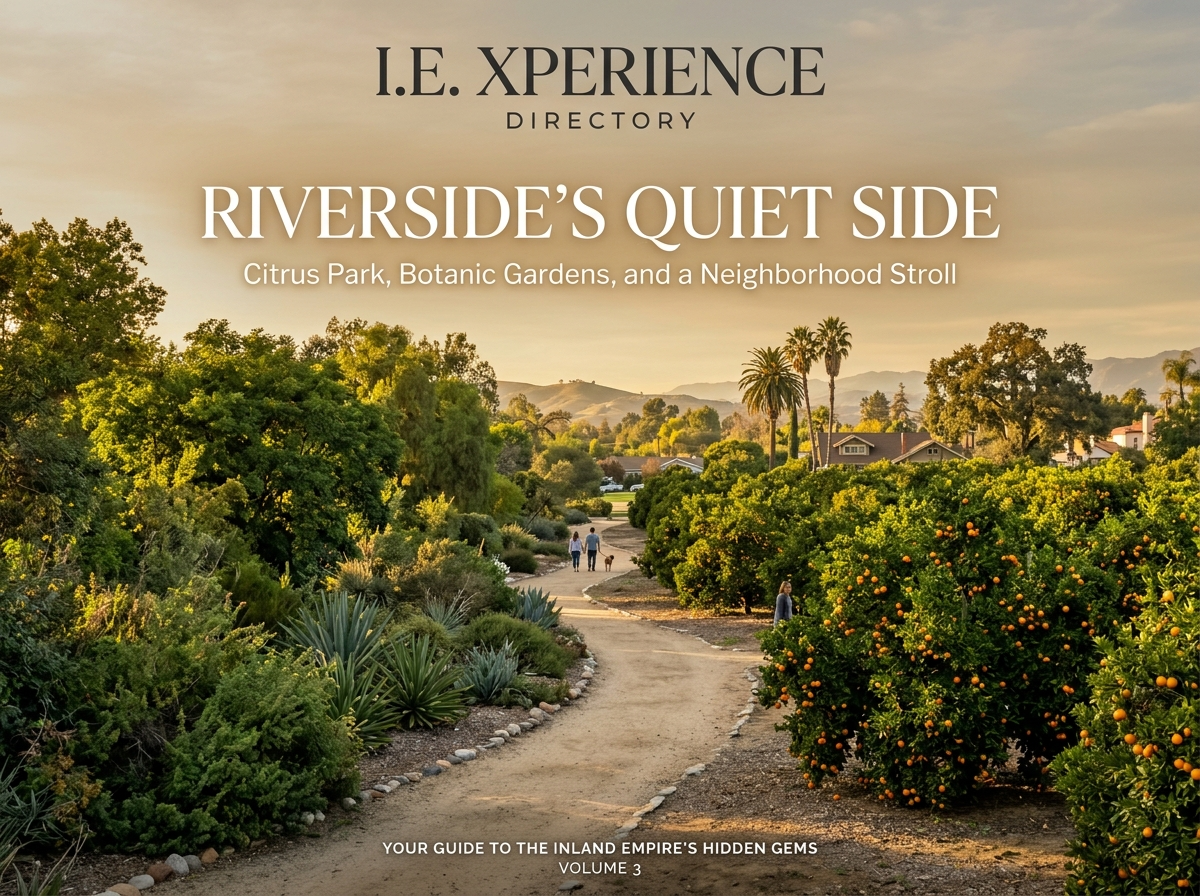
Riverside’s Quiet Side: Citrus Park, Botanic Gardens, and a Neighborhood Stroll
Riverside has the Mission Inn and a busy downtown, but it also has a quieter circuit that covers the city’s citrus history and a large botanic garden without requiring a full day of driving or parking hassles.
Begin at the Parent Washington Navel Tree at Magnolia and Arlington Avenues. The tree, planted in 1873 by Eliza Tibbets, is the living source of nearly all commercial Washington navel oranges grown in California. It is enclosed for protection, marked with interpretive signs, and free to visit. The stop takes fifteen to twenty minutes. It is the shortest way to see the actual starting point of the industry that once made Riverside one of the wealthiest cities in the country.
From there drive to California Citrus State Historic Park at 9400 Dufferin Avenue. The park is a 248-acre open-air museum with demonstration groves, a visitor center (open Friday–Sunday), and trails through rows of citrus. Day-use fee applies. You can walk the groves, read the exhibits on packing and labor history, and see how the landscape was organized when citrus was the dominant crop. Most people spend one to two hours. Picnic tables are available if you bring food.
If you want a third outdoor stop, the University of California, Riverside Botanic Gardens cover 40 acres with themed sections, including desert, herb, and subtropical plantings. The gardens are open most days with a small admission fee or donation. Trails are well maintained and the elevation gives views toward the mountains on clear days. It pairs naturally with the citrus park because both are about cultivated landscapes rather than wilderness.
A slower alternative or addition is a walk around parts of the older residential neighborhoods near the Parent Tree or toward Fairmount Park. Fairmount Park has lakes, mature trees, and paved paths. Early morning or late afternoon is the calmest. None of these stops require tickets in advance or special equipment.
A practical order for a half-day or full morning-into-afternoon looks like this: Parent Tree first (quick), Citrus State Historic Park second (main walking time), then either the Botanic Gardens or a neighborhood/park stroll, followed by lunch at one of the long-running local restaurants in the area. Riverside has plenty of independent spots that are not aimed at tourists. Choosing one near your last stop keeps the driving minimal.
Parking is available at each location. The Citrus Park and Botanic Gardens have designated lots. The Parent Tree has street parking nearby. Crowds are usually light except during occasional park events or peak spring bloom periods.
The advantage of this circuit is that it stays inside Riverside and still covers the agricultural story that shaped the city and much of the Inland Empire. You see the original tree, the preserved groves, and a modern botanic collection without leaving the area. It works on a weekday when downtown is busier or on a weekend when you want to avoid event traffic.
Check current hours for the Citrus Park visitor center and the Botanic Gardens before you go. Both can have seasonal adjustments.
I.E. Xperience tracks these kinds of days because they show a side of the Inland Empire that does not always make the short lists. If you film any part of the circuit—the Parent Tree, the groves, the gardens, or a meal afterward—send the video to xperience@iex.directory with the subject VIDEO REVIEW. Local restaurants and attractions can claim or add listings on iex.directory.
The tree is still there. The groves are still maintained. And the quieter parts of Riverside are open any day you decide to drive over and walk through them.
I.E. Xperience | Inland Empire Entertainment Directory | iex.directory